
A field theory can be defined whenever a physical system can be described in terms of two sets of variables: one set is called the dependent set or the field variables (or simply the fields) and the other set comprises the independent variables. Then the behaviour of the system is known whenever the values of the fields are known in terms of the independent variables. The fields are connected to the independent variables through one or more equations (the so-called field equations), which specify their dynamics. For example, classical mechanics is a field theory in this sense: time is the independent variable and the coordinates defining the system configuration are the fields, and then the Euler-Lagrange equations constitute the field equations. Again, electromagnetism is a field theory: the space-time coordinates are the independent variables and the six components of the electric and magnetic fields are the field variables, and then Maxwell equations are the field equations.
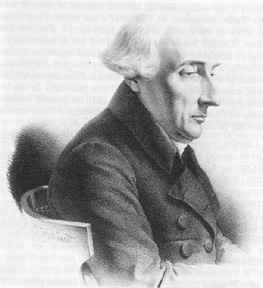
In physics, the field equations are generally deduced from a variational principle. The technique for doing this is to find stationary value of the action , a quantity built out of the Lagrangian. Nature seems to obey stationary principles, especially minimal principles, and this is what motivates the principle of stationary action . The mathematical procedure involved dates back to the 18th century and stems from the work of the great Torinese mathematician Joseph-Luis Lagrange and his Méchanique analytique. The dynamics of the system turns out to be entirely described by a function (more technically, a scalar density) called the Lagrangian of the system, from which the field equations are derived by following a well-defined algorithm.
|
The two standard ways of deriving the equations that describe the dynamics of a system were devised by Lagrange (left) and Hamilton (right), respectively. | |
In the years 1834/35 the Irish mathematician Sir William Rowan Hamilton put forward a different method for describing the dynamics of a mechanical system based on a set of two first order differential equations, the so-called Hamilton equations. In many interesting cases, the Langrangian and the Hamiltonian formulations turn out to be equivalent. In relativistic field theory, though, this equivalence is lost since the Lagrangian of the system usually fails to satisfy some regularity conditions owing to the requirement of general covariance. For the same reason the Lagrangian formulation is naturally tailored to describe (classical) fields in flat or curved space-time, including gravity itself. Conversely, the (canonical) Hamiltonian formulation is based on the ADM 3+1 non-covariant splitting of space-time into space and time, the latter playing a primary role in describing the evolution of the system.
The Hamiltonian formulation, besides providing further insight in the physical interpretation of a classical field theory, turns out also to be the first step towards a canonical quantization of the theory. Many covariant extensions of the Hamiltonian formalism to field theory have been proposed, some of which having a clear-cut geometric meaning. Many quantization procedures have also been put forward, but it is generally agreed at present that we are still lacking a satisfactory quantum theory of gravity because of both technical and fundamental issues.
 |
 |